


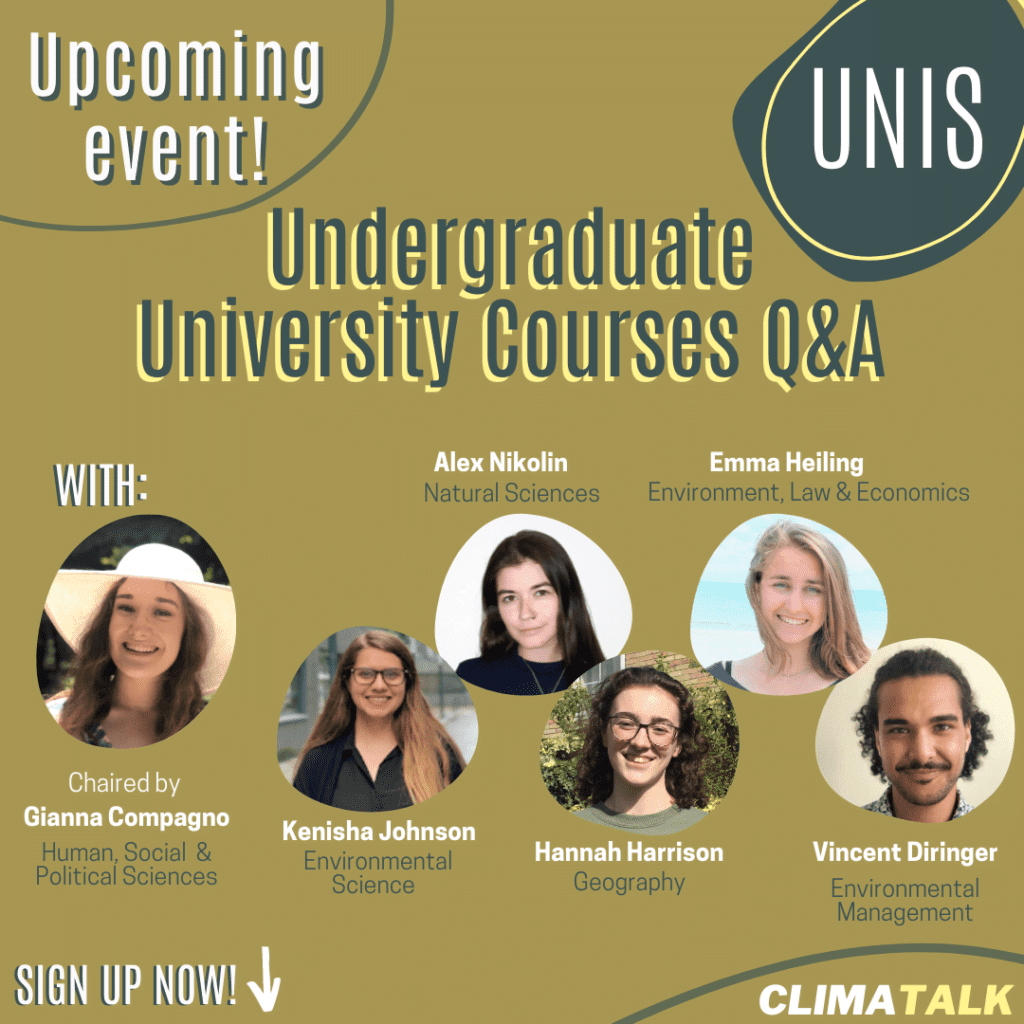
Below are the notes from the Undergraduate University Courses Q&A by ClimaTalk that occurred on 21st October at 6:00 PM BST
by Sadiyah Ahmed
Date: 21/09/21
Time: 18:00 BST
Speakers: Gianna Compagno, Kenisha Johnson, Alexandra Nikolin, Hannah Harrison, Emma Heiling, Vincent Diringer
35 attendees altogether; 25 attendees excluding Sadiyah and the panel.
Question 1: Why did you choose Cambridge or the UK over a course in the United States?
- The American system is very broad and you spend your first few years covering a lot of different subjects – Gianna knew where she was going to study and was able to enter into exactly what she wanted to do. She liked this education system and being able to focus on exactly what she wanted to do.
Question 2: Where’s a good place to get work experience for environmental law?
- Client Earth – An amazing law firm focusing on the Earth.
- Link: https://www.clientearth.org/latest/latest-updates/stories/how-to-become-an-environmental-lawyer-in-the-uk/
Question 3: What opportunities after a degree are available in terms of the humanitarian sides?
- It will depend on your location. In the UN, they’re often looking for interns starting at a masters level. He did his studies in Australia – it was fairly easy to find work experience because there was not as much competition. You need to know what you’re interested in and where you’re located – send out emails to organisations you’re interested in. Keep going at it even If you don’t get a reply.
Question 4: Which Russel group Unis offer a sustainability course?
- Direct to ClimaTalk’s uni course map – Undergraduate courses are not as broad as Master’s courses so they tend to be just environmental science you can’t specialise as much. Russell group universities will have some sustainable courses. LSE specialises more on environmental stuff so has more options.
- Birmingham – BSc Environmental Sciences (with option of professional placement);
- Cardiff – Environmental Geography, Environmental Geoscience, Environmental Sustainability Science;
- Durham – Climate Science, Environmental Geoscience;
- Edinburgh – Ecological and Environmental Sciences (with Management);
- Exeter – Environmental science, Business and Environment;
- Glasgow – Environmental Geoscience;
- Leeds – Environment and Business, Sustainability and Environmental Management; Ecology and Conservation Biology, Environmental Science (lots here);
- Liverpool – Environmental Science;
- LSE – Environment and Development, Environmental Policy with Economics;
- Manchester – Environmental Science;
- Newcastle – Environmental Science.
- Gianna- Even if a course feels broad there will be options to specialise within that.
Question 5: Clarify the differences between natural sciences and environmental sciences and what you can do with them?
- Natural sciences is more of a pure science degree.You start with the basics and learn about your science as a whole without any particular direction. It is quite broad and you can do any science. She did a range of different sciences in her first year and second year and then specialized a bit more in third year. But you need to look at the structure of courses as each course is different and each uni is as well. In natural sciences, there is a lot you can do because of how broad it is. You can go into research, industry. You get a range of transferable skills.
- Environmental Science takes the natural sciences and applies them specifically to environmental problems. It is a 4 year degree. First year is very broad, after it you have the opportunity to specialise a lot. You can go into academia, careers related to ecology or become an environmental analyst.
Question 6: What type of work would you do with NGOs and what doors would that open?
- Depends on the NGO: there are a lot of NGOs and there are a lot of different positions. There are various departments within each NGO. E.g legal department. It’s very varied, there’s a communication/media aspect, and a political side of things because NGOs often have a lot to do with lobbying and political issues.
- The big thing with NGOs is that they are usually working with limited funds. Being able to volunteer with them is already a step up and will help launch you upwards. Could be as easy as helping with social media and then you’ll get to know people. NGOs don’t always have funds so volunteers are usually highly recommended.
Question 7: How did you find studying in universities in Europe where English is not the first language, would you need to be fluent in the native language to study there?
- For the UK, when you apply you need to do an English test to ensure you have the level which is necessary. The better your level of English the easier it will be, but don’t be discouraged, you do get used to it quite quickly.
- Emma is studying her masters in France, currently all her courses are in English. For Master’s in different countries, it is typical for them to be in English. Don’t let the language barrier hold you back, but having a good level of communication does help.
- In a lot of European Universities you will find courses in English. Part-time jobs can be difficult to find if you don’t speak the country’s native language.
- In the Netherlands for example, English is widely spoken. Tuition money varies depending on the country.
Question 8: Which is more beneficial, doing a uni course with a ‘study’ year abroad or doing a uni course with a placement year in the environmental/sustainability sector?
- It would have to be the placement year for universities, NGOs or companies to employ you. It is very beneficial.
- Depending on what it is that you want, being able to have a bit more work experience whilst you’re doing your degree helps to contextualise your degree.
The environmental field is very competitive.
Question 9: Is it possible to do a science-related degree without a science A-level?
- Hannah did 3 A levels: Geography; English Language and Theology, Philosophy and Ethics and none of them were science related but bio-geography units in the first year of her degree were fine for her. Not having a science at A level is completely fine for geography at Cambridge.
Question 10: Hi, I’m currently in year 11. I am debating on whether I should go for childcare or being an environmental researcher. If I was to choose environmental research, what courses do you suggest I do and how do I get there from where I am now?
- In year 11 you’ll be focusing on picking your A levels – pick ones which you enjoy and did well at in GCSE. All of your A levels can link, you just need to find their links. It’s still very early days for you! Your plans might change – Hannah’s have, she wanted to be a Geography teacher and now she does not! But focus on what you enjoy. Follow any groups you are interested in. Take each year as it comes and you’ll be perfectly fine.
Question 11: What working experience is there for animal conservation?
- Depends what in animal conversation you want to do because it is very broad. There’s the research side like looking into genetics – lab work would be good for this. Another good thing would be just to volunteer with an organisation who does Animal conservation work. But it depends what type of animal conservation you are interested in – tailor it to your interests.
Question 12: Are there any specific books that you found particularly useful and interesting in terms of a personal statement and wider reading to do with the environment?
- Prisoners of Geography, by Tim Marshall: provides a good introduction into borders and geo-politics.
- All We Can Save, by Ayana Elizabeth Johnson and Katherine Wilkinson. An anthology of essays and poems of women at the forefront of the climate movement. It’s very new and would be a good addition to the personal statement.
- This Changes Everything, by Naomi Klein – breaks down environmental concepts and makes it very easy and clear
- Kind Earth would be great if you want to go into environmental law.
- Keep up with current affairs. Documentaries are great too.
For example: “Seeing it is believing it’
Question 13: What courses in university would be good to study to pursue a career related to the environment?
- Birmingham – College of Life and Environmental Sciences
- Cardiff – College of Physical Sciences and Engineering includes Earth and Environmental Sciences Academic School
- Exeter – College of Life and Environmental Sciences
- Imperial – Centre for Environmental Policy within Faculty of Natural Sciences
- Leeds – Faculty of Environment
- Liverpool – School of Environmental Sciences
- LSE – Department of Geography and Environment
- Manchester – Department of Earth and Environmental Sciences within School of Natural Sciences
- Newcastle – School of Natural and Environmental Sciences
- Just some examples but the most important thing is that you like the course!
- It’s really important to do what you’re interested in. These environmental organisations need a variety of different professionals so if you do what you enjoy then you will be able to contribute the best.
Question 14: Due to COVID-19 many NGOs are not offering in person work experience? Do you know of anywhere which offers work experience; and do you?
- Unpaid – there are a lot of opportunities, including at ClimaTalk.
- Youth programs
- NGOs in your area
- Bigger NGOs
- Internships
- Springpod
- Voiz – offer sustainability analyst internships
Question 15: I’m about to apply to the same school as Emma. I am hesitating between international energy or environmental policy. What brought you to decide which masters to do and where to study?
- The environmental policy masters is very practically originated as opposed to Bachelors in the UK which are very content and academic based. In Paris, it’s very hands-on. You’re not just writing essays and then having an exam at the end of the year. Deciding on your Master’s depends on your interests. Depends on what you want to go into as well. You do have a lot of options.
Question 16: Do you have any suggestions which are specific to starting a Master’s?
- For the Master’s personal statement you can tailor it to a specific university. You can really show them why you want to study that course and what experience you have relating to that university. Why do you want to come to that university/ location?
Question 17: Can anyone give an example of what they added to their personal statement which showed interest in environmentalism other than books?
- Musician – performing in nursing homes (relates more to humanitarianism)
- Work experience which relates to what you want to do.
- If A-levels relate to your course, you have the necessary experience – essays you wrote, group work, field trips.
- Any volunteering experience – Wildlife trust
- Essay competitions – Compass magazine (Cambridge’s Geography magazine – even if you don’t win it can show your willingness to engage with your course outside of the classroom, on a deeper level.)
- Weekend trips to Unis – experiences uni life.
- Here is a free course you can do if you still have time to apply (year 12/11-) about nature-based solutions if that’s something relevant to you which would also show interest: https://www.unep.org/events/online-event/massive-open-online-course-mooc-nature-based-solutions-disaster-and-climate
Question 18: What are universities looking for in a Geography student?
- 2 key characteristics:
1) Loving learning! – The Geography course, especially if you’re doing one which entails both human geography and physical, will be a lot to learn. That depth is what Hannah loves. If you can show enthusiasm from gathering knowledge -You’re not going to be the best at everything but have a go!
2) Empathetic person – some of the topics you touch can be quite upsetting – inequality, homelessness, the consequences of the climate crisis. Show that you’re not going to just regurgitate what you have learnt but you’re rather going to apply it in your wider life e.g. by volunteering etc.
Question 19: Does the media influence how the climate crisis is perceived?
- Hubs of knowledge: How to Save a Planet podcast. The current media coverage is not sufficient but there are hubs of knowledge online.
- What the media does cover – it does not link it back to the climate crisis. E.g. A lot of refugees have to leave their homes partially due to the climate crisis. – it is a problem.
Question 20: Are there any careers which are not science related in the environment?
- There are loads: Policy, Law school – ESG law, Communications – nearly anything you want to do can be environmental. You can go into any field and be the person who’s interested in the environment, you can bring the change.
Question 21: Are there any courses which focus on prioritising the environment through architecture ?
- There are quite a few opportunities, look at the ClimaTalk university map.
- Any of the major architecture schools are promoting their own sustainable architecture programs.
- You can find an angle to make it yours be it environmental or science related.
Question 22: If you want to go into animal conversation to positively impact animal lives, which subject or field should someone do at university.
- If you have an idea of what you want to do, then go into research – drug testing/ drug development degrees.
- If it’s more general, then natural sciences is quite a good bet.
- Undergraduate courses are not as specialised.
Question 23: Is an environmental business a sustainable full time job?
- Answer is definitely yes, it’s such a big sector.
- Environmental consultants in Consulting firms.
- Businesses are being restructured to be more environmentally aware.
Question 24: What work experience programs would you suggest?
- ClimaTalk – 11 sub teams
- Voiz
- Uni experience – Societies, student representatives, activism
- Lab work/ volunteering
- Get involved with societies
- Generation Climate Europe – different working groups to get involved with Sustainable Development, Circular Economy etc
- NGO experience
- Location based
- Vienna Environmental Department
Question 25: How long do courses take and how long will you be studying in uni?
- Standard 3-4 years, most other countries (apart from the UK) have a 3 year program – might be able to add on a placement year.
- Might have a time limit – so always take a look at that.
Question 26: What’s the best thing we as individuals do to help combat Climate change?
- Be conscious of the changes you can make. As you learn about it more you can realise that it is something you’re interested in. There is not a wrong way to approach it – wherever you think your skills are, you can help the most.
- Planetary boundaries framework- talks a lot about tipping points and what boundaries we can cross and come back from.